DeepSeek-V4-Flash
deepseek-v4-flash-0731 ↗| Rate | Old flat | Off-peak | Peak |
|---|---|---|---|
| Input · cache hit | $0.0028 | $0.007 2.5× | $0.014 5× |
| Input · cache miss | $0.14 | $0.22 1.6× | $0.44 3.1× |
| Output | $0.28 | $0.66 2.4× | $1.32 4.7× |
Analysis · August 13, 2026
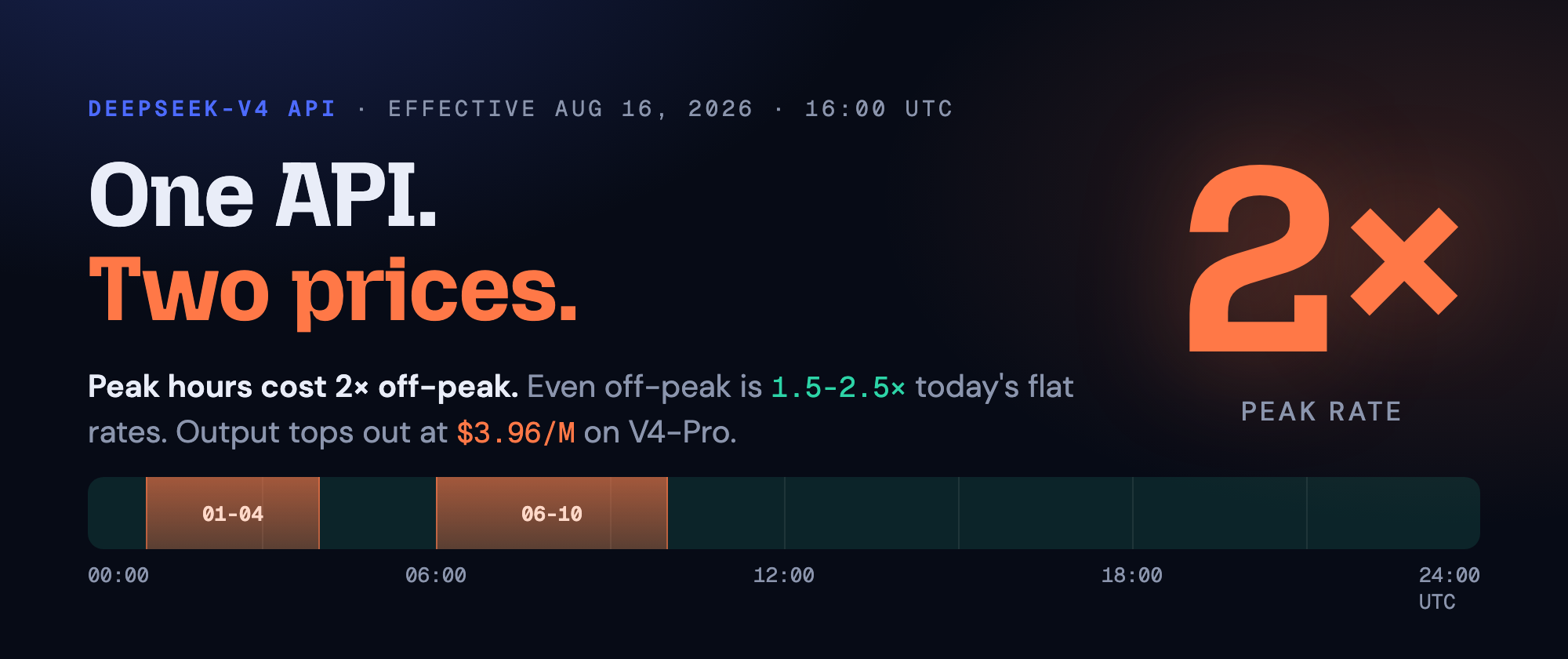
DeepSeek launched V4-Pro this week, and everyone is busy arguing about benchmarks. The change that will actually show up on your invoice got less attention: from 16:00 UTC on August 16, the DeepSeek API stops having a single price. What you pay depends on what time it is. For 7 hours a day, every token costs double.
Update, Aug 16: the pricing went live on schedule at 16:00 UTC. This analysis was written three days before the switch; every "flat rate" below is what DeepSeek charged until then, kept for comparison. The tracker shows the current window in real time.
Before looking at the peak windows, look at what "off-peak" means against the flat rates it replaced. All prices are USD per 1M tokens, and "old" is the flat rate DeepSeek charged until Aug 16 (first-party, as listed on OpenRouter):
Off-peak output costs about 2.3 to 2.4 times the old flat rate. The peak window only decides how much more you pay, never whether. This is a price increase wearing a time-of-day costume, and off-peak is the soft landing.
The single number that stings most: Pro cache-hit input goes from $0.003625 to $0.044 at peak, a 12.1× jump. Prompt caching still wins by a mile in absolute terms ($0.044 for a hit vs $1.32 for a miss), but cache reads stop being a rounding error on your bill.
Peak hours are two fixed UTC blocks, 7 hours a day in total:
The other 17 hours are off-peak.
Now convert those windows to China Standard Time: 9am-12pm and 2pm-6pm. That's a Beijing working day, almost to the minute. DeepSeek is surge-pricing its own domestic daytime load and discounting the hours when its GPUs would otherwise sit idle. It's the same logic as cloud spot pricing, applied to tokens, and it tells you where the capacity pressure is coming from.
This change leaked two months ago. In mid-June, a notice DeepSeek sent to Chinese API userssurfaced on r/DeepSeek: V4 was planned for mid-July, and peak/off-peak billing would arrive with it. That email defines the peak windows as 9:00-12:00 and 14:00-18:00 Beijing time. Convert from UTC+8 and you get exactly the two UTC blocks announced this week. The "Beijing working day" reading isn't an interpretation, it's how DeepSeek wrote the policy in the first place.
The interesting part is what changed between the plan and the launch. Convert the email's CNY prices at the June exchange rate and the July plan reads: off-peak stays at the flat rates of the time, peak costs double. V4-Pro off-peak was listed at 3元 per 1M input tokens, about $0.44, which is basically the flat $0.435. Flash off-peak was 1元, about $0.15, next to the flat $0.14. The final announcement scrapped that: off-peak now sits 1.5 to 2.5 times above current rates, and peak doubles from there. Somewhere in the last month, the whole curve moved up, not just the peak.
One consolation from the same email, which the English coverage hasn't mentioned: DeepSeek says billing changes come with 24 hours of advance notice, and users who disagree can opt out and request a refund. Worth knowing. The usual caveat applies, since this comes from a community screenshot of an email rather than an official English announcement.
US and EU policymakers have spent the year debating restrictions on Chinese open-weight models. Export rules, procurement bans, op-eds about security. Meanwhile, look at who lands in the cheap hours under this rate card. US business hours land almost entirely off-peak, and Europe gives up its morning but keeps the afternoon. Asia-Pacific daytime takes the full surge. A startup hammering the API at 2pm in San Francisco pays half of what a startup in Shanghai pays at 2pm local time.
So the markets doing the loudest lobbying against Chinese open-weight models are the ones this pricing quietly subsidizes. If DeepSeek wanted to keep Western developers hooked, it could not have designed the rate card better. I don't think that's a conspiracy, for what it's worth. It's just what happens when your load curve follows one country's daylight and your customers are everywhere. But the irony is sitting right there.
If your DeepSeek usage is interactive, chat or agents responding to users, you can't move it. You pay whatever your users' clock says. But a surprising amount of LLM spend is schedulable: batch enrichment, evals, embeddings backfills, report generation, synthetic data. For all of that, the rule fits in one line: stay out of 01:00-04:00 and 06:00-10:00 UTC.
The check is trivial, because the windows are fixed UTC blocks:
// peak: 01:00-04:00 & 06:00-10:00 UTC
function isDeepSeekPeak(date = new Date()) {
  const m = date.getUTCHours() * 60 + date.getUTCMinutes();
  return (m >= 60 && m < 240) || (m >= 360 && m < 600);
}
A nightly batch at 0 12 * * * UTC costs half of the identical job at0 7 * * *. Same tokens, same model, half the bill. And if the work is cache-friendly, aim it at Flash off-peak cache hits. At $0.007/M, those are the cheapest tokens on the board.
The home page of this site does the UTC math for you: whether it's peak right now, the windows on your local clock and everyone else's, and a countdown to the moment the new pricing kicks in. For scripts, there's a free JSON endpoint at/api/status with the current window and the next change time, and a subscribable calendar of the peak windows.
Time-of-day pricing for LLM APIs was probably inevitable. Inference capacity is physical, demand follows the sun, and DeepSeek is just the first major provider to print that on the rate card. If it works, others will follow, and "when did you run it?" turns into a normal column in AI cost dashboards.
August 16, 16:00 UTC came and went, on schedule. The clock is running now.
Not affiliated with DeepSeek. Confirm against the official price sheet before betting the invoice on it. Prices and effective date are from DeepSeek's announcement of August 13, 2026.